
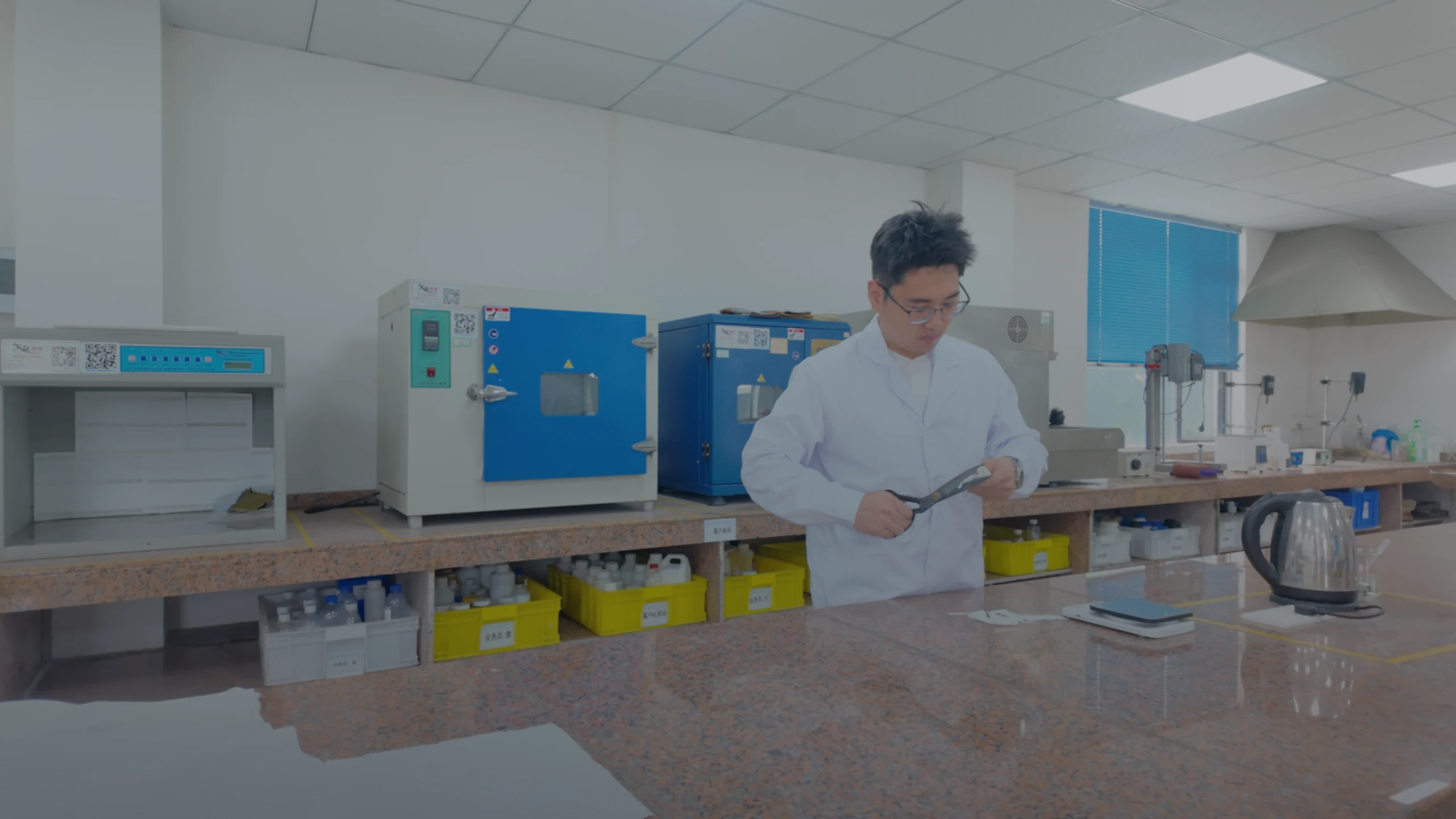
Uneven dyeing on woven cotton gets blamed on the dye, the water, or the machine. In a mill running starch-sized greige, the cause is usually upstream: a desizing step that removed 70% of the size and left 30% behind to block wetting. The answer is rarely more enzyme. It is measuring what is left.
This guide covers the enzymatic step in the woven cotton pretreatment route, from identifying the size on the greige to measuring what is left on the fabric.
Key takeaways
- Residual starch, not desizing enzyme dosage, is the usual cause of patchy dyeing on starch-sized greige.
- An α-amylase only removes starch — PVA and acrylic sizes need a different step.
- Measure with TEGEWA and capillary rise after the rinse, before scouring.
What a Desizing Enzyme Actually Removes
A desizing enzyme only removes what it is designed for. Before choosing a dosage, know what is on the greige:
| Size type | Removed by α-amylase? | What to do |
|---|---|---|
| Native starch | Yes | Standard enzymatic desizing |
| Modified starch (oxidised, etherified) | Mostly | Check with a TEGEWA test; some need a longer hold |
| PVA | No | Separate oxidative or PVA-degrading step |
| CMC / acrylic sizes | Partly | Blend or pre-treatment needed |
| Starch + PVA blends | Starch only | Two-stage route, or accept a higher residual |
This is the first thing to check when a desizing trial “fails”: an amylase cannot break a polyvinyl alcohol chain, and no dosage increase will change that.
How a Desizing Enzyme Removes Starch
This is a liquid α-amylase that works across a broad temperature range (30–100°C) and hydrolyses α-1,4 glycosidic bonds at random. Long chains become dextrins, then oligosaccharides, then soluble fragments that rinse away. Three practical consequences follow:
- It is endo-acting. It cuts in the middle, so viscosity drops fast — which is why the bath thins within minutes.
- It cannot cut α-1,6 branch points. Highly branched starches leave limit dextrins behind; that residual is what shows up on the TEGEWA scale.
- It is a protein. Oxidants, heavy metals and extreme pH denature it. A bath carrying residual hypochlorite will inactivate the enzyme before it does any work.
Enzymes are specific by design: an amylase works on starch and nothing else, while a cellulase works on cellulose. If your route also includes bio-polishing, that is a different product and a different step — the desizing enzyme will not touch it.
Why Desizing Decides Dye Uptake
Residual starch is not just dirt. It changes how the fabric wets, and wetting controls how the dye strikes. Where a film of size remains, the liquor penetrates more slowly, the fibre takes dye at a different rate, and the result is a patchy or streaky shade that no levelling agent can correct after the fact. This is why a desizing enzyme that leaves 5% residue can produce a cleaner shade than one that leaves 20% at twice the dosage.
It also compounds downstream. Starch that survives desizing is carried into the scouring bath, where it raises the COD, consumes alkali, and can re-deposit on the fabric as a grey haze. A desizing enzyme that is checked at the pad, not assumed at the end of the line, is the cheapest way to protect the whole route.
Product Specifications
| Property | Value |
|---|---|
| Physical form | Yellowish translucent liquid |
| pH (as supplied) | 4.5–5.5 |
| Working temperature | 30–100°C; optimal 50–90°C |
| Suitable sizes | All common starch pastes |
| Packaging | 25 kg drum |
| APEO | Free |
| Certifications | ZDHC MRSL Level 3 conformant · OEKO-TEX conformant · REACH conformant · GOTS-aligned · ISO 9001 certified |
Because the desizing enzyme is a liquid formulation with no APEO, it is dosed as supplied and needs no dispersing step. The enzyme does not attack cellulose, so fibre strength is preserved even when the hold runs long — the opposite of oxidative desizing.
For buyer audits, the documentation is usually the first thing requested: ZDHC MRSL Level 3 conformity, OEKO-TEX and REACH conformity, a GOTS-aligned range and ISO 9001 certification. Test reports and certificates are available for any product on request.
The Five Parameters That Decide It
These are the levers that matter. The values below are the specification of this product; confirm dosage against the TDS before setting a recipe.
| Parameter | This product | What happens outside it |
|---|---|---|
| pH | 4.5–5.5 | Above 5.5 activity falls sharply; below 4.0 the rate slows |
| Temperature | 30–100°C; optimal 50–90°C | Below 50°C the rate drops; above 90°C keep the hold short |
| Dosage (pad-batch) | 0.5–1.0 g/L | Start at 0.5; go up only if TEGEWA stays above 2 |
| Dosage (exhaust) | 0.2–0.5% o.w.f. | Start at 0.2; check liquor ratio before scaling |
| Time | 30–60 min exhaust; 8–24 h pad-batch | Shorter holds leave dextrins that still block wetting |
Two more that are not on most spec sheets: water hardness (calcium can stabilise some amylases and inhibit others) and the presence of chelating agents, which can strip the calcium a calcium-dependent enzyme needs. Note the pH window: this is an acid amylase, so a bath drifting toward neutral is the most common reason a working recipe suddenly stops working.
The dosage range is deliberately low. A liquid concentrate rated across 30–100°C is fast at the top of the window, so a small dose does the work; starting at 0.5 g/L and stepping up is cheaper than starting at 2 g/L and wondering why the rinse never clears.
How to Measure Desizing (the Step Most Mills Skip)
If you do not measure residual starch, you are guessing. Four methods, in order of practicality:
- Iodine spot test. Drop iodine on the fabric: blue-black means starch is still there. Fast, qualitative, good for a quick pass/fail.
- TEGEWA violet scale. Compare the stained fabric against a 1–9 reference. This is the standard the industry quotes; 1 is clean, 9 is heavy.
- Capillary rise. Measure how fast water climbs a strip. Poor wetting after desizing is a strong signal of residual size.
- Weight loss / extraction. Weigh before and after, or extract the residual starch and read it by iodine spectrophotometry. Slower, but the only quantitative number.
Measure after the rinse and before scouring. Measuring after bleaching tells you nothing useful, because the alkali has already removed some of what you were trying to detect.
When a “Failed” Desizing Isn’t the Enzyme
Most failed trials are blamed on the desizing enzyme. In practice the chemistry is rarely the problem; the process around it is.
| Symptom | Likely cause | What to check |
|---|---|---|
| Patchy residue across the width | Uneven padding, not chemistry | Pad pressure, nip uniformity, liquor pick-up |
| No effect at all | pH drifted above 5.5, or oxidant in the bath | pH meter, residual chlorine, water source |
| Heavy foam | Surfactant in the formulation or the bath | Wetting agent type and dose |
| Starch gone but fabric still hard | Wax and pectin left | This is a scouring problem, not desizing |
| Low strength after the full route | Scouring/bleaching damage | Caustic dose, temperature, time |
Enzymatic vs Oxidative Desizing
| Oxidative (persulphate / bromate) | Enzymatic (α-amylase) | |
|---|---|---|
| Cellulose damage | Possible | None at recommended conditions |
| Halogenated by-products | Possible with bromate; none with persulphate | None |
| COD load | Higher | Lower |
| PVA removal | Partial | None |
| Compatibility with dyeing | Needs thorough rinse | Rinses clean |
Recipe: Pad-Batch and Exhaust
| Pad-batch | Exhaust | |
|---|---|---|
| Dosage | 0.5–1.0 g/L | 0.2–0.5% o.w.f. |
| pH | 4.5–5.5 | 4.5–5.5 |
| Temperature | 50–80°C at padding | 50–90°C |
| Hold | 8–24 h at ambient | 30–60 min |
| Rinse | Hot, then cold | Hot, then cold |
| Verify | TEGEWA 1–2 and capillary rise | TEGEWA 1–2 and capillary rise |
To fix the number for your own greige, run a gradient: 0.2 / 0.4 / 0.6 / 0.8 / 1.0 g/L at the pad, or 0.1 / 0.2 / 0.3 / 0.4 / 0.5% o.w.f. in exhaust. Pick the lowest dose that reaches TEGEWA 1–2 and a capillary rise that matches your dyeing recipe. Starting high hides a formulation problem; starting low and stepping up shows you where the curve actually turns.
After the Hold: Adjust pH, Then Deactivate
Two steps are easy to skip and expensive to get wrong:
- Adjust pH before you start. This is an acid amylase: bring the bath to 4.5–5.5 with acetic acid, and check with a calibrated meter rather than litmus paper. A bath sitting at pH 6–7 will show almost no activity — and that looks exactly like a bad batch of enzyme.
- Deactivate before the next bath. After the hold, raise the temperature above 90°C for a few minutes, or rinse thoroughly, so no active desizing enzyme is carried forward into scouring or dyeing.
What It Costs per Tonne
A desizing enzyme looks expensive per kilogram and cheap per tonne of fabric, because the dosage is low. The number worth comparing is not the drum price but the cost per tonne of greige, including rinse water and effluent load. Two grades at the same price can differ by a factor of two in dosage, and that is the only comparison that matters at scale.
Run the maths on your own numbers: dosage (g/L or % o.w.f.) × liquor ratio × price per kilogram. Then add the rinse volume, because a desizing enzyme that needs three rinses instead of two can cost more in water than it saves in chemical.
Worked example, illustrative numbers only: at 1.0 g/L in a 1:10 liquor ratio, one kilogram of fabric sees 10 L of liquor, so 10 g of enzyme — 10 kg per tonne of greige. At ¥30/kg that is about ¥300 per tonne of fabric. Substitute your own price and liquor ratio; the arithmetic does not change.
Desizing is one step in the pretreatment range; the scouring and bleaching stages that follow are covered under energy solutions.
For mills working toward Oeko-Tex Standard 100 or ZDHC, the desizing stage is the first place to document: it sets the size chemistry and the effluent load for everything downstream.
What It Won’t Do
Worth stating plainly before a trial:
- It won’t remove PVA. That needs an oxidative step or a dedicated PVA-degrading blend.
- It won’t replace scouring. Starch removal is not wax removal; the two are separate jobs.
- It won’t work in a bath carrying residual oxidant. Check the water and the previous bath first.
- It won’t fix uneven padding. If the residue is patchy across the width, the problem is mechanical.
Frequently Asked Questions
Can I use one desizing enzyme for starch and PVA blends?
Not on its own. α-amylase only hydrolyses starch; the PVA fraction needs an oxidative or specialised step.
What dosage should I start with?
0.5–1.0 g/L for pad-batch or 0.2–0.5% o.w.f. for exhaust. Start at the low end and step up with a gradient until TEGEWA reaches 1–2.
Why does the bath stop working after a few hours?
Most likely pH drift out of the 4.5–5.5 window, or enzyme inactivation. Check pH and confirm there is no residual oxidant in the water.
Does temperature above 90°C destroy the enzyme?
Not this one — it is rated to 100°C. The optimal window is 50–90°C, so above 90°C keep the hold short and verify residual starch.
How do I know desizing is complete?
TEGEWA 1–2 plus a good capillary rise. Iodine is a fast check but only tells you starch is present, not how much.
Is enzymatic desizing cheaper than oxidative?
Usually on chemical cost and always on effluent load, but the comparison depends on the size type and the rinse volume. Run the numbers per tonne.
Is the enzyme safe for workers and the effluent?
It is a protein, not a solvent; the effluent load is lower than oxidative desizing. Handle as a dust-free liquid and follow the SDS.
The Short Version
Desizing is a measurement problem before it is a chemistry problem. Confirm what size is on the greige, set pH and temperature inside the enzyme’s window, then measure residual starch with TEGEWA and capillary rise before you change the dosage. Most “failed” trials turn out to be a pH drift, a residual oxidant, or a PVA blend the amylase was never able to remove.
Next Step
About the author. The Hua Lian technical team formulates and supplies desizing enzymes and pretreatment auxiliaries for woven and knit mills, and runs lab trials on customer greige before a recipe goes to the line.
Send a greige sample and we will run a dosage gradient, measure residual starch and capillary rise, and give you a recipe you can pilot on one machine. Request a sample.
Related reading. For the step that decides polyester fastness after dyeing, see Acid Cleaning Agent: reductive clearing for polyester.
[…] reading. If your route also includes starch-sized woven greige, see the desizing enzyme guide; for low-temperature pretreatment chemistry, see low-temperature pretreatment […]
[…] your route also starts with starch-sized woven greige, the desizing step decides dye uniformity before the dye ever goes in. For denim washing enzymes, see Water Free […]
[…] Related reading. Enzymes are specific: cellulase works on cellulose, amylase works on starch. If your route starts with starch-sized woven greige, see the desizing enzyme guide. […]