
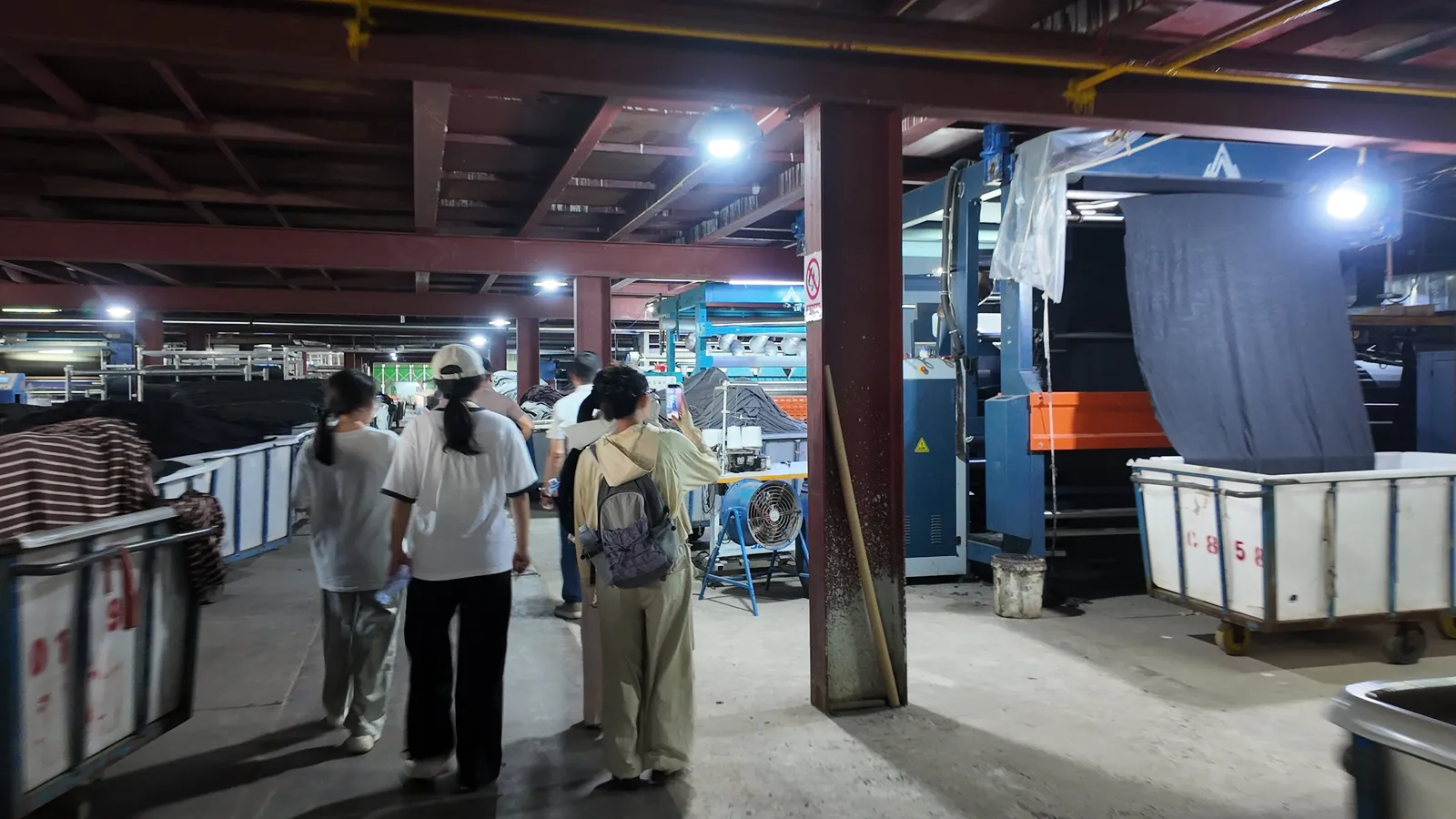
Water Free Powder Enzyme did not start as a product launch. It started as a call from a mill in Bangladesh whose stretch denim was coming back at an 8% rework rate — not for color, not for hand feel, but for holes. The fabric was tearing at the seams and failing strength tests, over-processed by the very tools meant to fade it. That call is the reason this powder exists.
In one sentence: Water Free Powder Enzyme is a neutral cellulase powder that fades denim at the fiber surface — and stops there — so you get the fade without the over-processing that tears stretch denim.
Key takeaways
- Built to fix an 8% rework rate caused by over-processing: holes and strength loss on stretch denim.
- Surface-only action fades the cotton without eating into the yarn core, so tensile and tear strength stay intact.
- A controlled process — pH 6.0–7.5, 40–60°C, 0.25–1.5% owg, 30–120 min — plus a hard deactivation step prevents over-processing.
- Cuts pumice use by 50–70% and lowers water and energy demand.
The Problem — Over-Processing Is What Tears Stretch Denim
Ask a denim finisher what kills a stretch batch and the answer is rarely the fade. It is the strength. Get the abrasion even slightly wrong and the fabric fails at exactly the places it is stressed most — the seams, the knees, the crotch — and comes back as holes and failed tear tests.
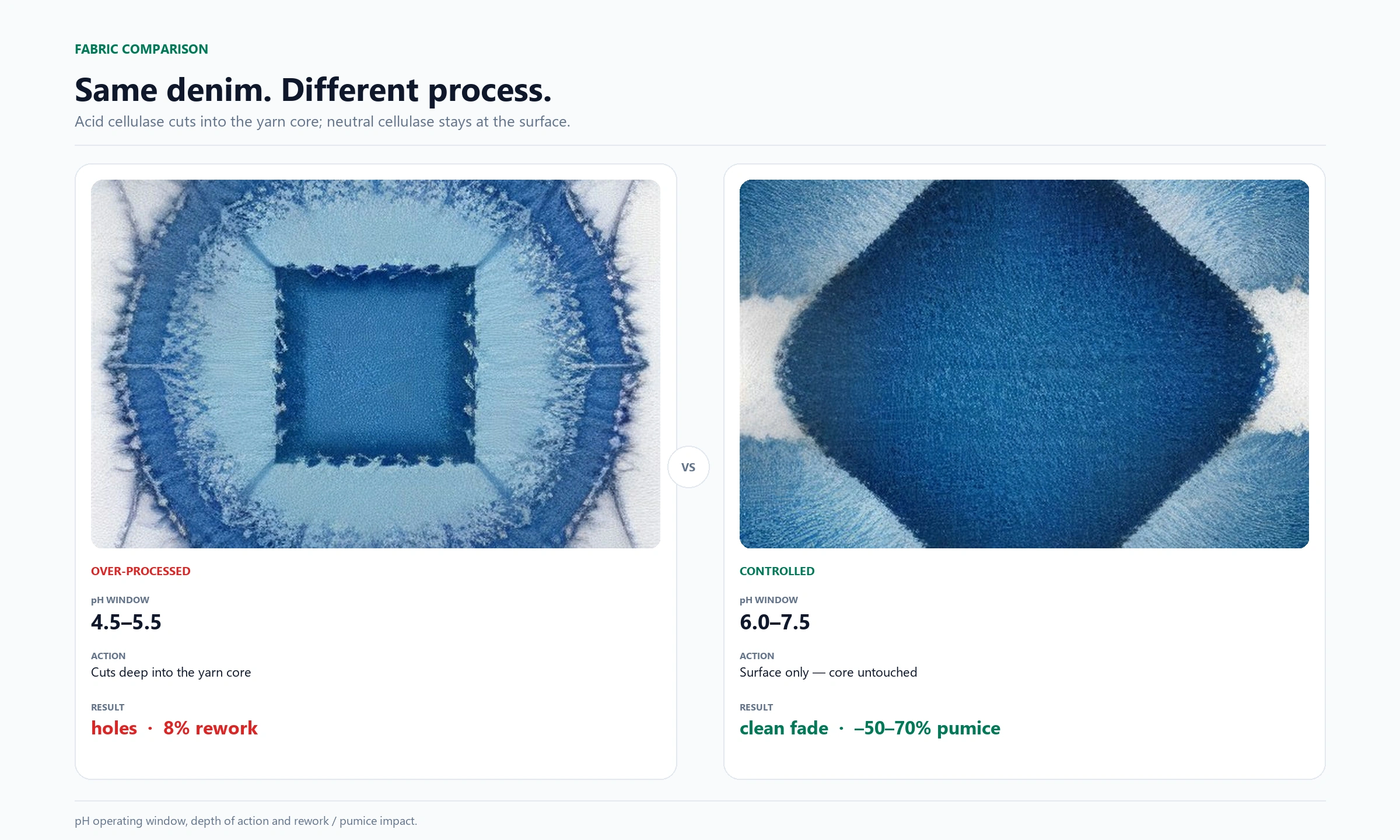
Two tools cause most of it. Acid cellulase works at pH 4.5–5.5 and keeps cutting until you stop it; leave it too long or dose too high, and it hydrolyzes deep into the cellulose, quietly eating the strength out of the yarn. Stone tumbling does the same damage mechanically, hammering the weak points until the fabric parts. On stretch denim there is a third factor: the elastane. Over-process the cotton and you expose and damage the elastane too.
The result is a batch that looks faded but cannot be shipped — the strength numbers do not pass, or the holes show up in finishing. 8% is the number that got our attention.
The Fix — Fade the Surface, Then Stop
Water Free Powder Enzyme is a neutral cellulase, supplied as a powder. The design constraint was simple: remove enough indigo to get the fade, and remove nothing else.
Cotton is cellulose in two forms — dense, strong crystalline regions and loose, accessible amorphous regions, with the indigo sitting on the surface. The enzyme cleaves the 1,4-β-D-glucosidic bonds on that surface, releasing short-chain sugars and carrying the dye off. The enzyme molecule is much larger than a water molecule, so it cannot fit into the fiber core. That is the whole point: it physically cannot over-process the way an acid cellulase or a rock can. It fades the surface and stops.
The second half of the fix is that you control exactly when it stops. The bath runs at pH 6.0–7.5 and 40–60°C, and the reaction is killed on command — raise the bath to 80°C or take the pH to 10+ and the enzyme denatures. Over-processing happens when a process cannot be stopped; this one is stopped deliberately, every batch.
Neutral vs Acid Cellulase: Where the Strength Loss Comes From
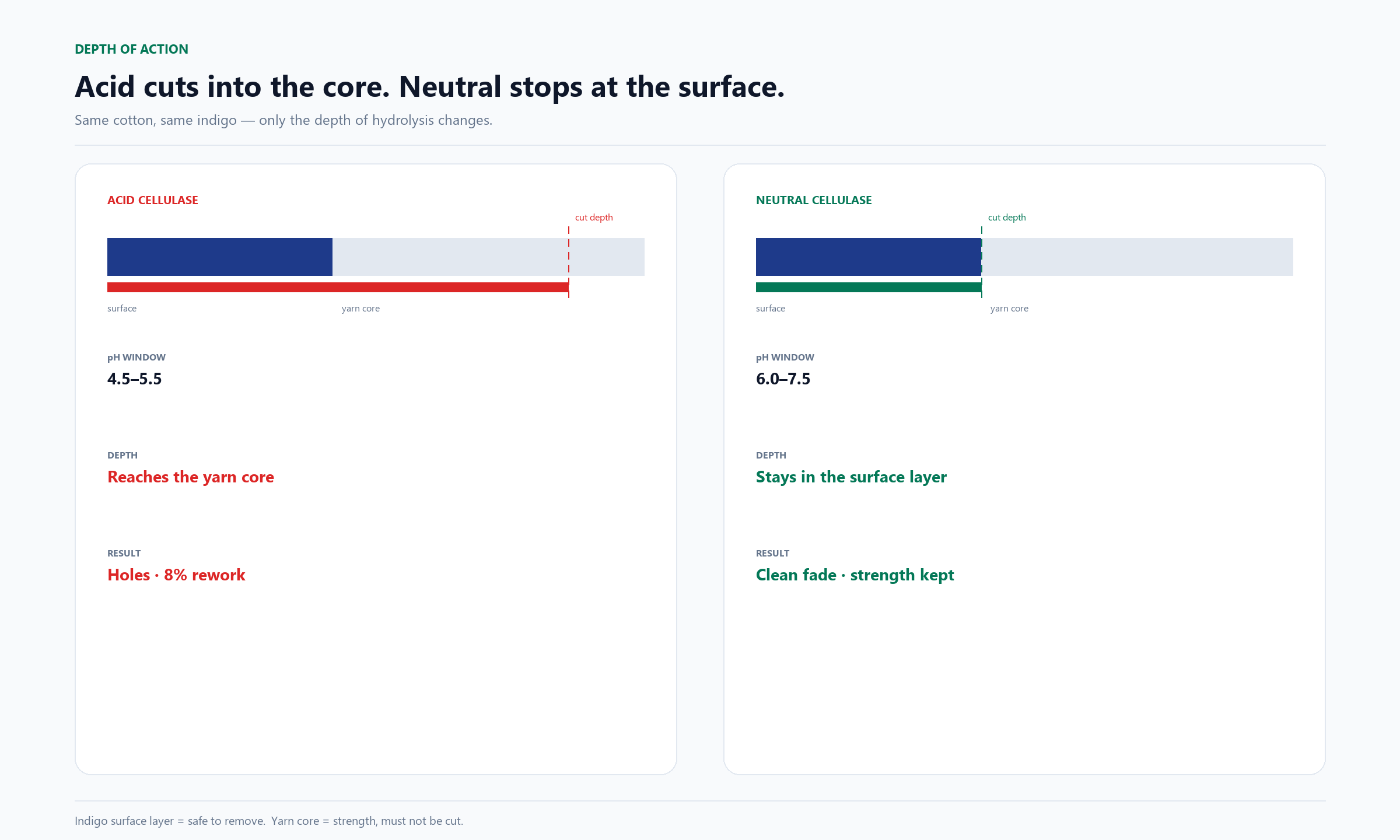
Most denim mills know acid cellulase well. The difference shows up most clearly at exactly the point where that 8% was lost — in the strength of the fabric.
| Factor | Acid cellulase | Water Free Powder Enzyme (neutral) |
|---|---|---|
| Working pH | ~4.5–5.5 | 6.0–7.5 |
| Action depth | Penetrates, keeps cutting | Surface-only |
| Over-processing risk | High — strength loss, holes | Low — cannot reach fiber core, plus a hard stop |
| Back-staining | Common — indigo re-deposits | Largely suppressed above pH 6.0 |
| Elastane / stretch denim | Attacked, loses recovery | Protected |
| Best for | Heavy abrasion where strength loss is acceptable | Fade plus strength retention on stretch denim |
Read the Spec Sheet Like an Engineer
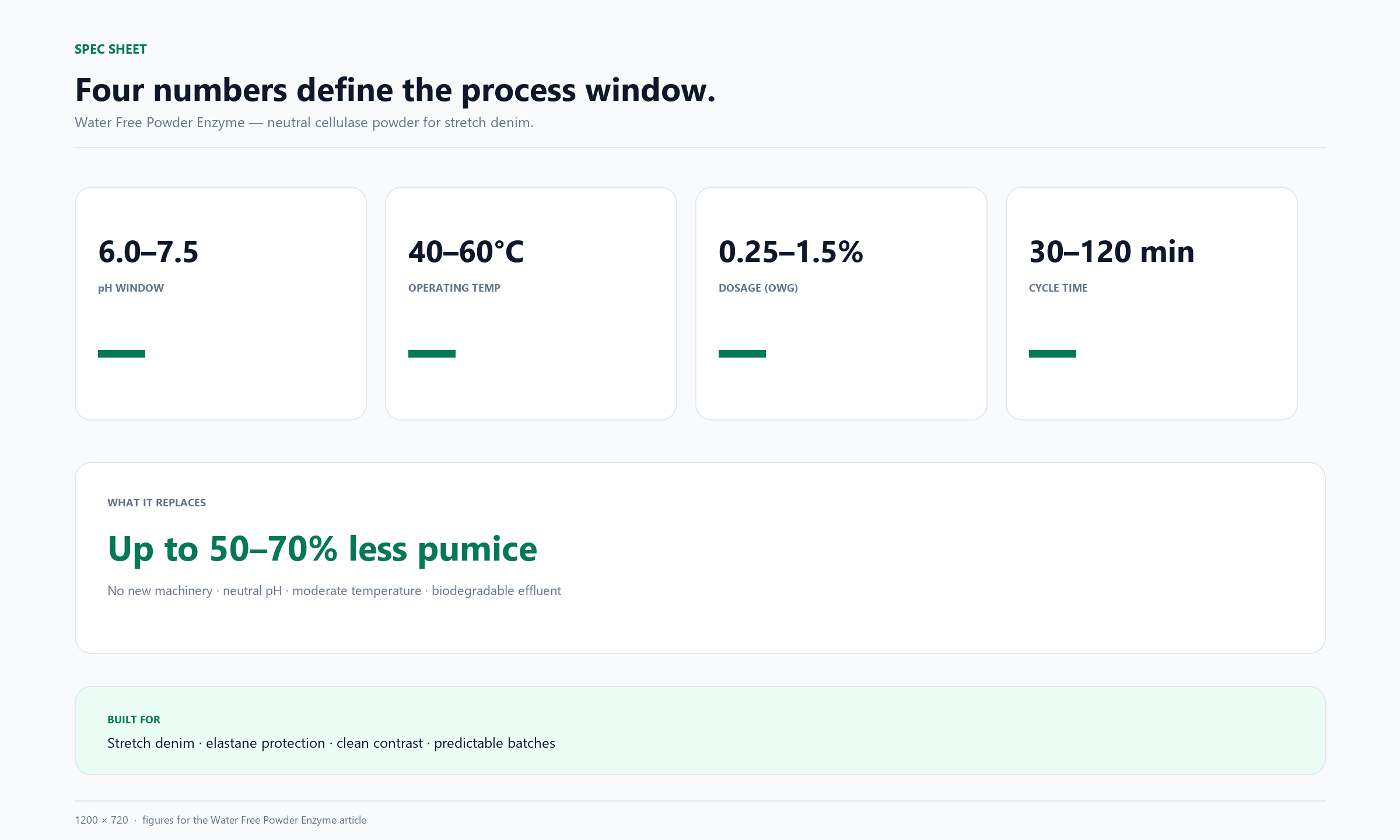
Here is the data sheet — and, more usefully, what each line means when the thing you are protecting is the strength of the fabric.
| Parameter | Specification | What it means to you |
|---|---|---|
| Optimal pH window | 6.0–7.5 | The neutral window that keeps the enzyme gentle and suppresses back-staining at the same time. |
| Temperature range | 40–60°C | Moderate heat does the job — no high-temperature boil that stresses the yarn and elastane. |
| Recommended dosage | 0.25–1.5% owg | Your fade dial and your safety limit. Stay in range and you control how much surface comes off. |
| Processing time | 30–120 min | Short enough to prevent over-processing, long enough for heavy contrast when a PO needs it. |
| Physical form | Concentrated powder | Stable shelf life, lighter freight, and accurate low-dose metering straight into the bath. |
See the full product specifications for this and the rest of the denim range.
How to Use Water Free Powder Enzyme on a Wash Line
No new machines. You run Water Free Powder Enzyme in the washers you already have. The sequence:
- Desize first. If size is still on the fabric, the enzyme cannot reach the cotton and you get patchy results.
- Fill to a liquor ratio of 1:10–1:15.
- Dose 0.25%–1.5% on weight of garment (owg). Start low, sample, and go higher only if you need more contrast.
- Set pH to 6.0–7.5 (acetic acid or a buffer) and hold the bath at 50–55°C.
- Run 30–60 minutes and check color every 10–15 minutes.
- Stop the reaction — this is the step that prevents the holes. Raise the bath to 80°C or pH 10+ (soda ash) to denature the enzyme, then rinse and dry.
Three rules that stop most bad batches before they start:
- Watch pH and temperature the whole run. A drifting bath is what over-processing actually looks like.
- Never steam-reheat a cooled bath. You will cook the enzyme, not revive it.
- New fabric = pilot first. Dose and time are per-construction, not universal.
See our step-by-step denim washing application guide for machine setup and troubleshooting.
How to Spot Over-Processing Before It Ships
Over-processing rarely shows up as an obvious hole on the first day. Watch these signals during and after the wash, and stop before the batch reaches finishing:
- Weight loss climbing. Weigh a sample cloth before and after the cycle. If weight loss trends above your usual range, the enzyme is cutting too long.
- Weak seams and stress points. Pull a seam, knee and crotch on a sample garment. Fraying or a thin, soft hand feel points to strength loss.
- Tear strength drifting down. Compare the current batch with your standard. A downward drift is the earliest warning before holes appear.
- Color that keeps deepening. If the fade is still moving well past your target time, the bath is drifting and should be stopped.
With Water Free Powder Enzyme, the control sits in the deactivation step: raise the bath to 80°C or take pH to 10+ the moment the target is reached, and never let a drifting bath run on.
What It Won’t Do (Read This Before You Buy)
Enzyme suppliers rarely list the limitations. Here are ours, plainly:
- It won’t fix bad desizing. If starch or PVA is still on the fabric, the enzyme cannot reach the cotton and you will get uneven fading. Desizing has to happen first.
- It won’t reproduce a stone wash’s exact texture. Stone abrasion leaves a random, harsher surface; enzyme gives cleaner, more uniform contrast. If a buyer wants that specific rocky abrasion pattern, this is the wrong tool for that one spec.
- It isn’t a dry process. “Water free” means it strips out most of the water and energy stone washing wastes — not that the bath is dry.
- It’s precise, not foolproof. Skip the deactivation step or let the pH drift and you can still over-process and lose strength. The protection comes from running the controls.
Frequently Asked Questions
What problem was this product built to solve?
An 8% rework rate at a mill in Bangladesh, caused by over-processing — stretch denim coming back with holes and failing strength tests.
How do I avoid over-processing my denim?
Use a surface-only neutral cellulase, hold pH 6.0–7.5 and 40–60°C, and always run the deactivation step (80°C or pH 10+) to stop the reaction on time.
What is the difference between neutral and acid cellulase?
Acid cellulase works at ~pH 4.5–5.5 and keeps cutting until you stop it, so it risks strength loss and holes. Neutral cellulase works at pH 6.0–7.5, acts only on the fiber surface, and is stopped deliberately.
Does it work on stretch denim?
That is what Water Free Powder Enzyme was built for. Its surface-only action protects the yarn core and the elastane, so strength and recovery stay intact.
What dosage should I start with?
Start at the low end of the 0.25%–1.5% owg range and sample every 10–15 minutes. Fade intensity is dosage- and time-driven, so pilot on your fabric before full runs.
How do I stop the reaction?
Raise the bath to 80°C or raise pH to 10+ with soda ash. Either permanently denatures the enzyme — this deactivation step is what prevents over-processing.
What temperature should I run at?
40–60°C, with 50–55°C as the recommended operating range for most constructions.
Is it compatible with my current chemicals?
It works with non-ionic surfactants and standard buffering agents, so most mills add no new chemical line.
Related reading. Enzymes are specific: cellulase works on cellulose, amylase works on starch. If your route starts with starch-sized woven greige, see the desizing enzyme guide.
Get a Trial Batch
If your stretch denim is coming back with holes or failing strength tests, the fastest way to find out what this changes is to run it on your line with your own numbers. Request a sample and the full data sheet, and we will help you calibrate dose and time on your fabric before the first full production run.
References
- Optimizing denim washing with cellulase enzymes (ScienceDirect, 2025)
- Role of Enzymes in Denim Washing (TextileToday)
- White Biotech Fact Sheet: Enzymes for Jeans (EuropaBio)
Related reading. For the step that decides polyester fastness after dyeing, see Acid Cleaning Agent: reductive clearing for polyester.
Leave a Reply