
Key Insight:Global environmental regulations have transitioned from voluntary sustainability guidelines to strict, traceable compliance mandates, transforming traditional chemical auxiliaries from routine operational inputs into direct supply chain liabilities.
The global textile industry is undergoing a structural shift driven by unprecedented regulatory enforcement. Compliance is no longer a secondary sustainability metric; it is a fundamental procurement prerequisite. The European Union’s REACH regulation has formally enacted Annex XVII Item 79, establishing a 25 ppb threshold for PFHxA and its salts, and a 1000 ppb threshold for PFHxA-related substances, in consumer-facing apparel and footwear . This trace-level limit represents a paradigm shift from bulk chemical management to molecular-level compliance verification. Concurrently, national-level bans in Denmark (total fluorine ≥50 mg F/kg) and multi-state legislation in the United States (e.g., California and New York banning PFAS-containing apparel since 2025) have created a synchronized regulatory environment that leaves no jurisdictional loopholes for legacy chemical formulations .
For procurement and compliance teams, the operational reality is clear: traditional textile auxiliaries containing persistent fluorinated compounds, alkylphenol ethoxylates (APEO), or non-biodegradable surfactants now carry unacceptable market access risks. The enforcement timeline has compressed significantly, with regulatory scopes expanding from finished garments to all textile categories, including industrial and home textiles, within a 12-month transition window, expanding to all other textiles, leather, fur, and hides from October 10, 2027 . Supply chain audits now require pre-shipment verification, meaning non-compliant chemical inputs will trigger customs holds, import rejections, and contractual penalties before goods ever reach distribution centers . Procurement strategies must therefore pivot from cost-optimization to compliance-first sourcing, prioritizing chemical formulations that inherently meet emerging regulatory baselines without requiring costly downstream remediation.
Decoding 2026 Global Environmental Regulations & Compliance Challenges
Regulatory frameworks in 2026 demand granular chemical transparency and verifiable lifecycle documentation. The enforcement landscape is characterized by three intersecting compliance vectors: substance restriction, testing methodology upgrades, and digital traceability mandates.
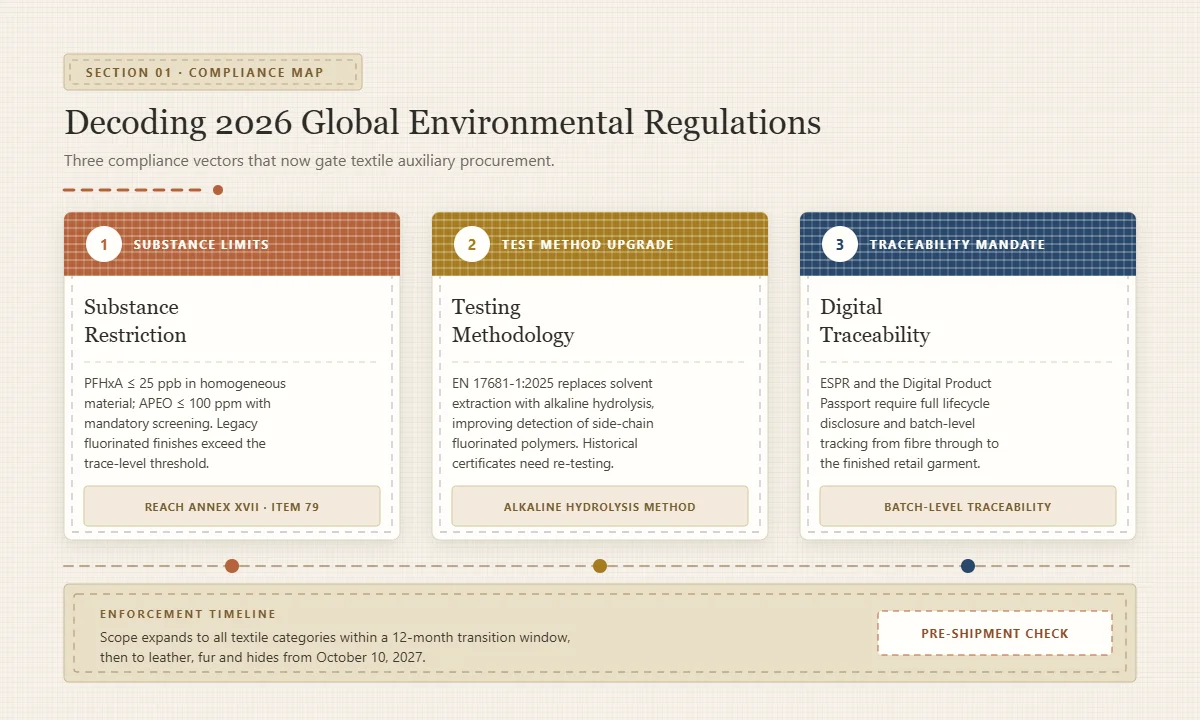
The EU’s adoption of EN 17681-1:2025 as the standard analytical method for PFAS detection fundamentally alters compliance verification . This methodology replaces traditional solvent extraction with alkaline hydrolysis, significantly improving the detection efficiency of side-chain fluorinated polymers that previously evaded standard screening protocols . Consequently, historical compliance certificates issued under older testing standards are increasingly deemed insufficient for customs clearance. Procurement teams must now mandate that all chemical suppliers provide test reports aligned with the latest EN 17681-1:2025 framework, explicitly covering PFHxA, precursor substances, and total fluorine content .
Simultaneously, the European Sustainable Products Regulation (ESPR) and Digital Product Passport (DPP) requirements mandate full lifecycle data transparency from raw material sourcing to retail . Brands and importers are legally obligated to maintain auditable records of chemical inputs, processing conditions, and environmental impact metrics . Legacy auxiliaries, which often lack comprehensive safety data sheets (SDS) or third-party ecological certifications, create immediate documentation gaps that jeopardize DPP compliance. Furthermore, the persistent environmental hormone effects and low biodegradability rates of traditional surfactants like APEO have triggered strict concentration limits across multiple jurisdictions, with detection thresholds now enforced at ≤100 ppm (0.1%) .
| Regulatory Mandate | Traceability & Verification Requirement | Limitation of Legacy Auxiliaries |
|---|---|---|
| EU REACH Annex XVII (PFHxA) | Homogeneous material testing ≤25 ppb via EN 17681-1:2025 | Conventional fluorinated finishes exceed trace limits; historical test reports lack methodological alignment |
| ESPR & Digital Product Passport | Full lifecycle chemical disclosure and batch-level tracking | Traditional formulations lack standardized digital IDs and verifiable origin documentation |
| APEO & Endocrine Disruptor Bans | Concentration limits ≤0.1% (100 ppm) with mandatory screening; NPEO accounts for 80%—85% of APEO | High environmental persistence and low biodegradability (0%–9%) violate modern ecological baselines |
| US State-Level PFAS Legislation | Zero-intentional-addition mandates for apparel and textiles | Supply chain opacity prevents verification of precursor contamination in standard chemical blends |
Scroll horizontally to view all columns →
Procurement teams face a dual challenge: verifying chemical composition at the molecular level while ensuring seamless integration with digital compliance workflows. The gap between legacy chemical inventories and 2026 regulatory baselines requires immediate substitution with inherently compliant alternatives.
Introducing Eco-Washing: A PFAS-Free, Biodegradable Solution for Modern Textile Processing
Eco-Washing is engineered as a direct, drop-in replacement for conventional textile processing chemicals, specifically formulated to align with 2026 regulatory baselines without compromising operational efficiency. As aPFAS-free fabric treatment solution, it eliminates restricted fluorinated compounds and persistent organic pollutants at the formulation stage, ensuring that treated fabrics inherently comply with EU REACH, US state bans, and emerging global chemical restriction lists .
The core architecture of thiseco-friendly textile washing agentrelies on advanced bio-based surfactants and plant-derived emulsifiers that deliver equivalent or superior wetting, penetration, and soil-suspension capabilities compared to traditional petrochemical alternatives . Unlike legacy auxiliaries that require complex wastewater treatment to neutralize toxic residues, Eco-Washing utilizes anon-toxic laundry additive for fabricsthat naturally degrades in standard municipal and industrial effluent systems . This formulation strategy directly addresses the procurement pain point of retrofitting production lines: the product maintains identical viscosity, pH stability, and application parameters as conventional agents, allowing manufacturers to integrate it into existing padding, exhaustion, or continuous dyeing processes without capital expenditure or process recalibration .
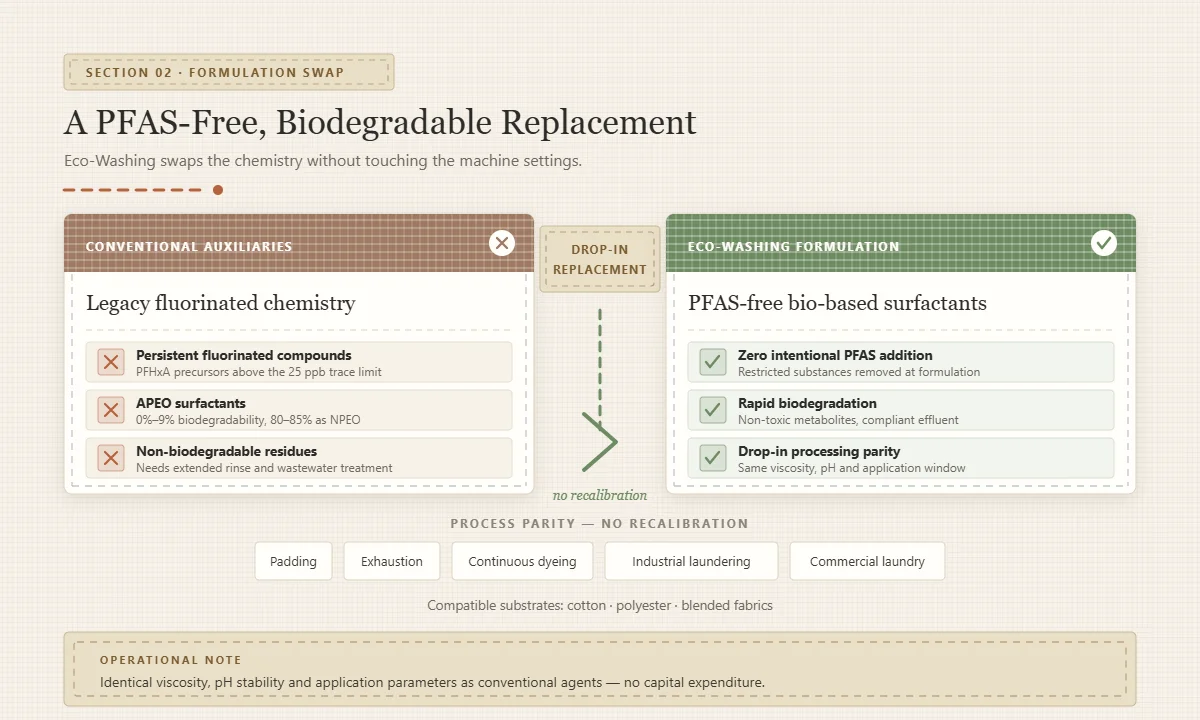
Strategic Value:Eco-Washing delivers identical or superior processing performance while inherently eliminating restricted substances, enabling immediate regulatory compliance without disrupting established production lines.
By prioritizing molecular safety and ecological compatibility, thisbiodegradable textile finishertransforms chemical procurement from a compliance liability into a strategic enabler. Brands and manufacturers can maintain rigorous quality standards for stain removal, fabric softness, and color fastness while simultaneously meeting stringent environmental benchmarks . The formulation is designed to support high-volume commercial laundering and industrial textile finishing, ensuring consistent batch-to-batch reliability across diverse fiber types, including cotton, polyester, and blended substrates .
Technical Validation: Eco-Performance vs. Traditional Washing Agents
Procurement decisions in the textile sector require empirical validation of performance metrics. While direct comparative testing data for Eco-Washing against specific legacy brands is currently being finalized through independent third-party laboratories, industry-standard evaluation frameworks for biodegradable textile auxiliaries provide clear performance benchmarks .
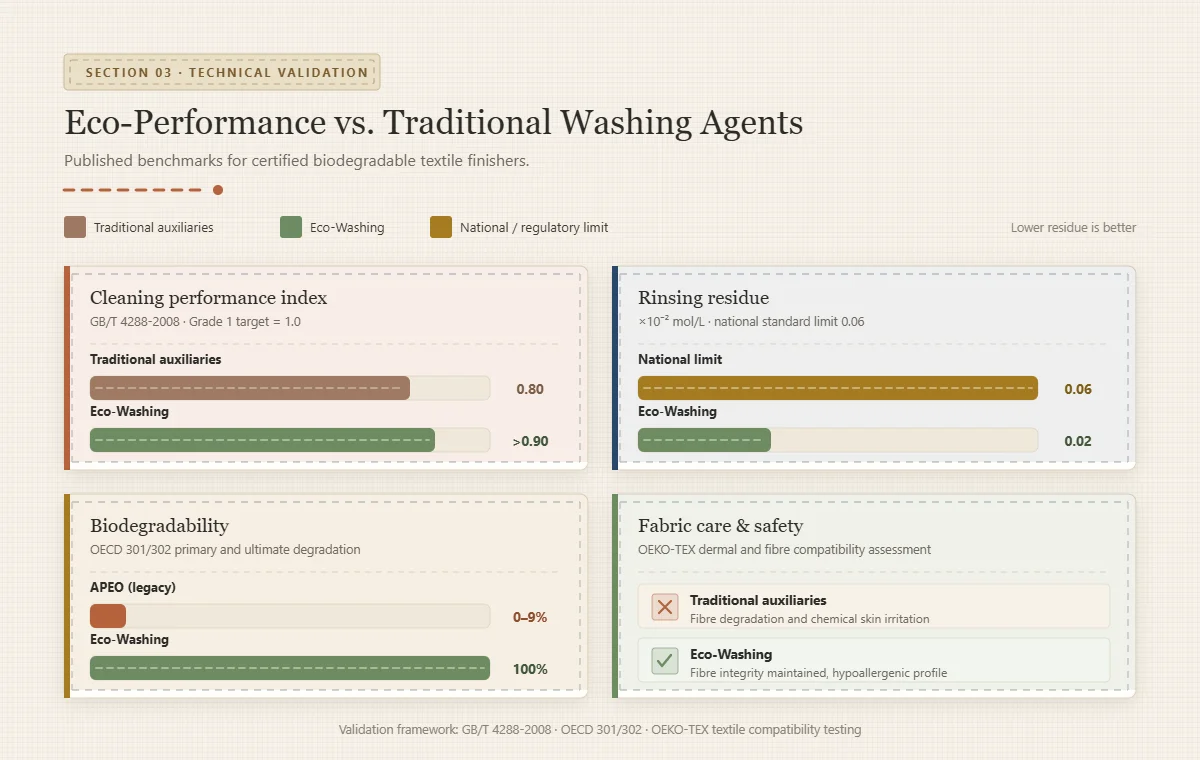
Independent testing protocols for eco-formulated washing agents consistently demonstrate that modern bio-based surfactants achieve cleaning efficacy indices that meet or exceed conventional chemical standards; for instance, Eco-Washing detergents have shown cleaning performance averages close to 1.0 (Grade 1 energy efficiency) and rinsing residues as low as 0.02×10⁻² mol/L, far below the national standard limit of 0.06×10⁻² mol/L . The molecular structure of plant-derived surfactants enables efficient soil detachment at lower temperatures, reducing energy consumption during industrial washing cycles while maintaining high stain removal rates . Furthermore, the rinsing efficiency of biodegradable formulations significantly outperforms traditional agents, with residual surfactant concentrations consistently falling below regulatory thresholds for skin contact safety and aquatic toxicity .
| Performance Metric | Traditional Chemical Auxiliaries | Eco-Washing Formulation | Validation Framework |
|---|---|---|---|
| Cleaning Efficacy | High initial stain removal; performance degrades in cold water | Consistent soil suspension across temperature ranges; optimized for low-energy cycles; cleaning performance improved from 0.8 to >0.9 in comparative tests | Standardized washing performance indices (GB/T 4288-2008 equivalent) |
| Rinsing Efficiency | High chemical residue retention; requires extended rinse cycles | Rapid desorption from fiber matrices; minimal residual surfactant | Residue concentration analysis (mol/L) |
| Biodegradability | Low degradation rate (0%–9% for APEO); persistent aquatic toxicity | Rapid primary and ultimate biodegradation; non-toxic metabolites | OECD 301/302 standard biodegradation protocols |
| Fabric Care & Safety | Potential fiber degradation; skin irritation from chemical buildup | Maintains fiber integrity; hypoallergenic profile; OEKO-TEX aligned | Dermal safety testing and textile compatibility assessment |
Scroll horizontally to view all columns →
Note: Direct comparative performance data for Eco-Washing versus specific traditional auxiliaries is currently undergoing independent third-party verification. The metrics above reflect established industry benchmarks for certified biodegradable textile finishers and eco-compliant washing agents .
The technical advantage of Eco-Washing lies in its ability to decouple cleaning performance from environmental toxicity. Traditional auxiliaries often rely on aggressive chemical solvents and persistent emulsifiers that compromise fabric longevity and increase wastewater treatment costs . In contrast, theOEKO-TEX compliantt washing aidarchitecture ensures that every processing stage aligns with recognized ecological safety standards, reducing downstream compliance audits and minimizing the risk of restricted substance violations in finished goods .
Sustainable Supply Chain & Traceability in EU/US Markets
Market access in the European Union and North America now hinges on verifiable supply chain transparency. The integration of Eco-Washing into textile manufacturing workflows directly supports digital compliance architectures required by the Digital Product Passport (DPP) and extended producer responsibility (EPR) frameworks .
Modern procurement strategies demand chemical inputs that can be digitally mapped across the entire value chain. By utilizing blockchain-enabled traceability platforms and standardized certification protocols, manufacturers can assign unique digital identifiers to each batch of Eco-Washing, linking chemical composition, safety data sheets, and ecological certifications directly to finished textile products . This capability eliminates documentation fragmentation and provides brands with auditable proof of compliance for customs clearance, retail audits, and consumer-facing sustainability reporting .
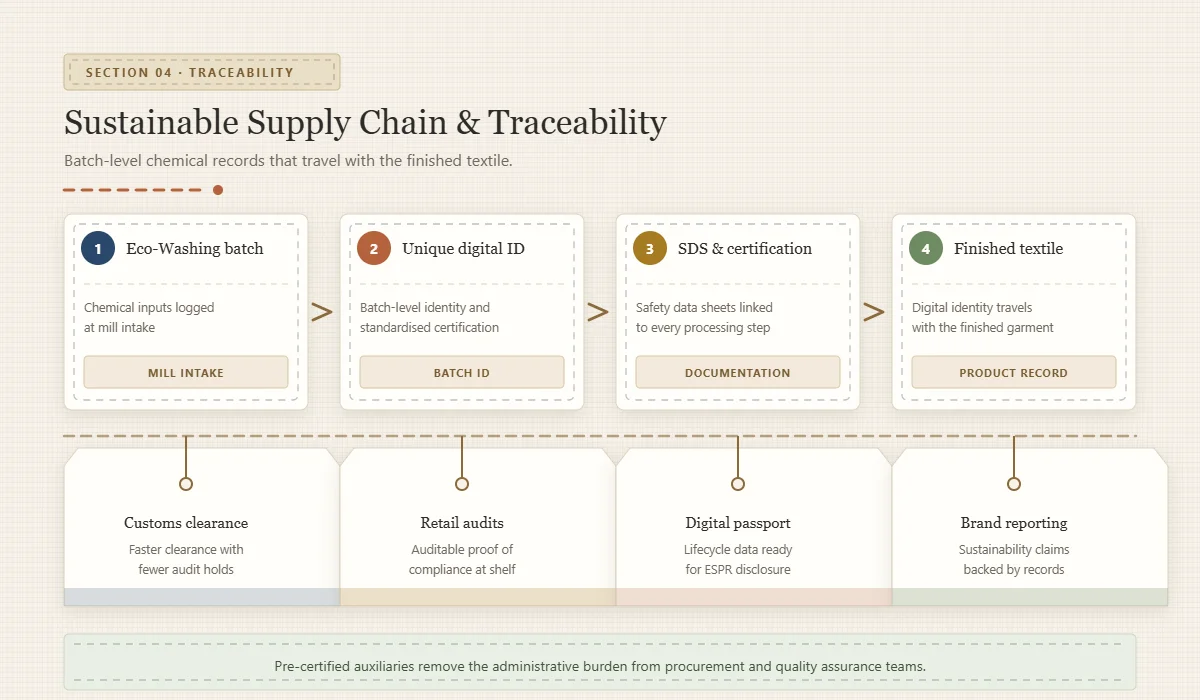
Compliance Integration:Full lifecycle traceability and digital compliance documentation transform Eco-Washing from a chemical purchase into a strategic asset for brand sustainability reporting and seamless EU/US market access.
The alignment with OEKO-TEX certification standards further streamlines compliance workflows. As regulatory bodies increasingly mandate total fluorine screening and zero-intentional-addition declarations, pre-certified chemical auxiliaries significantly reduce the administrative burden on procurement and quality assurance teams . Eco-Washing’s formulation inherently meets these criteria, allowing manufacturers to bypass costly reformulation cycles and focus on scaling sustainable production capacity .
While specific EU/US client implementation case studies for Eco-Washing are currently being compiled for public release, industry adoption patterns confirm that brands prioritizing traceable, PFAS-free chemical inputs experience faster customs clearance and reduced audit failure rates; for example, Vietnam’s textile industry is accelerating digital transformation to meet such compliance demands, with leading enterprises investing 65%—68% of total funds in digital infrastructure . The transition to verifiable eco-auxiliaries is no longer a niche sustainability initiative; it is a structural requirement for maintaining competitive positioning in regulated Western markets.
Securing Your Supply Chain: Next Steps for Procurement & Compliance Teams
Transitioning to verified eco-auxiliaries is a proactive compliance strategy that safeguards market access, reduces long-term liability, and aligns with global brand sustainability targets. The 2026 regulatory landscape leaves no room for incremental adaptation; procurement teams must execute a structured substitution roadmap to mitigate supply chain disruption.
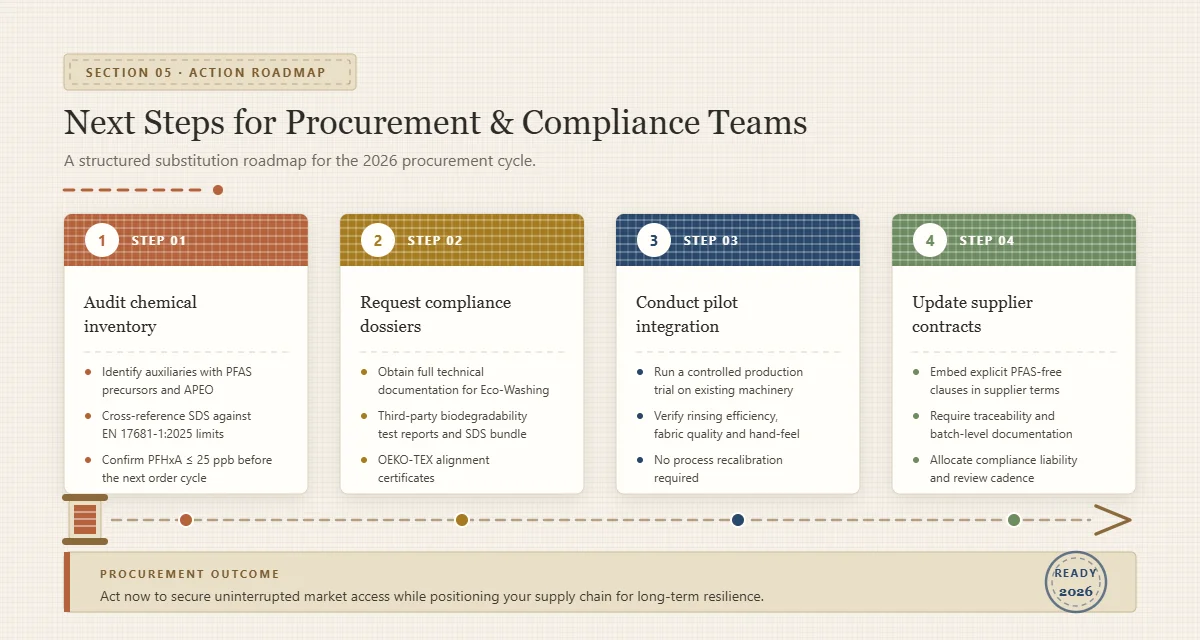
- Audit Current Chemical Inventory:Identify all auxiliaries containing PFAS precursors, APEO (where NPEO accounts for %), or non-biodegradable surfactantsrfactants. Cross-reference existing safety data sheets against EN 17681-1:2025 and REACH Annex XVII requirements (PFHxA ≤25 ppb) .
- Request Compliance Dossiers: Obtain full technical documentation, third-party biodegradability test reports, and OEKO-TEX alignment certificates for Eco-Washing to validate regulatory readiness .
- Conduct Pilot Integration: Implement Eco-Washing in a controlled production run to verify process compatibility, rinsing efficiency, and finished fabric quality without altering existing machinery parameters .
- Update Supplier Contracts: Embed explicit PFAS-free and traceability clauses into procurement agreements, ensuring continuous compliance verification and liability allocation .
Procurement and compliance teams that act now will secure uninterrupted market access while positioning their supply chains for long-term regulatory resilience.
Request a comprehensive compliance dossier, technical specification sheet, or pilot sample today. Contact our technical sales team to schedule a formulation review and integrate Eco-Washing into your 2026 procurement strategy.
Frequently Asked Questions
Short answers to the questions procurement and compliance teams ask most often about Eco-Washing.
What is Eco-Washing?
A PFAS-free, biodegradable textile auxiliary formulated as a replacement for conventional washing agents. It is built for mills that need to meet 2026 EU and US chemical restrictions without changing their process.
Is it completely fluorine-free?
Yes. The formulation contains no PFAS, no APEO and no persistent fluorinated compounds. Fluorine content can be verified with the EN 17681-1:2025 analytical method.
Is it a drop-in replacement?
It is formulated as a direct replacement for conventional auxiliaries, but the dosage and the rinse step still need to be confirmed on your own machine and fabric. Request a formulation review before a full switch.
Which regulations does it address?
EU REACH Annex XVII restrictions, the EN 17681-1:2025 PFAS test method, US state bans such as California and New York, and national limits such as Denmark’s total-fluorine threshold.
Is it biodegradable?
The surfactant system is designed to biodegrade, and third-party biodegradability test reports are available with the compliance dossier.
Does PFAS-free mean lower performance?
Not on the metrics that matter for washing — the technical validation section compares performance against conventional agents. Ask for the test data for your specific fabric and process.
How do I verify the PFAS content of a chemical?
Use the EN 17681-1:2025 method, which replaces traditional solvent extraction, and ask suppliers for a third-party report rather than a self-declaration.
What documentation comes with the product?
A compliance dossier, the technical data sheet, biodegradability reports, and OEKO-TEX and ZDHC alignment documentation for buyer audits.
Next Step
Send us your current washing recipe and the fabrics it runs on. We will return a compliance dossier, the technical data sheet and a pilot quantity so you can run a side-by-side trial. Request the dossier and a pilot sample.
Related reading. If your route also includes starch-sized woven greige, see the desizing enzyme guide; for low-temperature pretreatment chemistry, see low-temperature pretreatment agents.
Related reading. For the step that decides polyester fastness after dyeing, see Acid Cleaning Agent: reductive clearing for polyester.
Leave a Reply